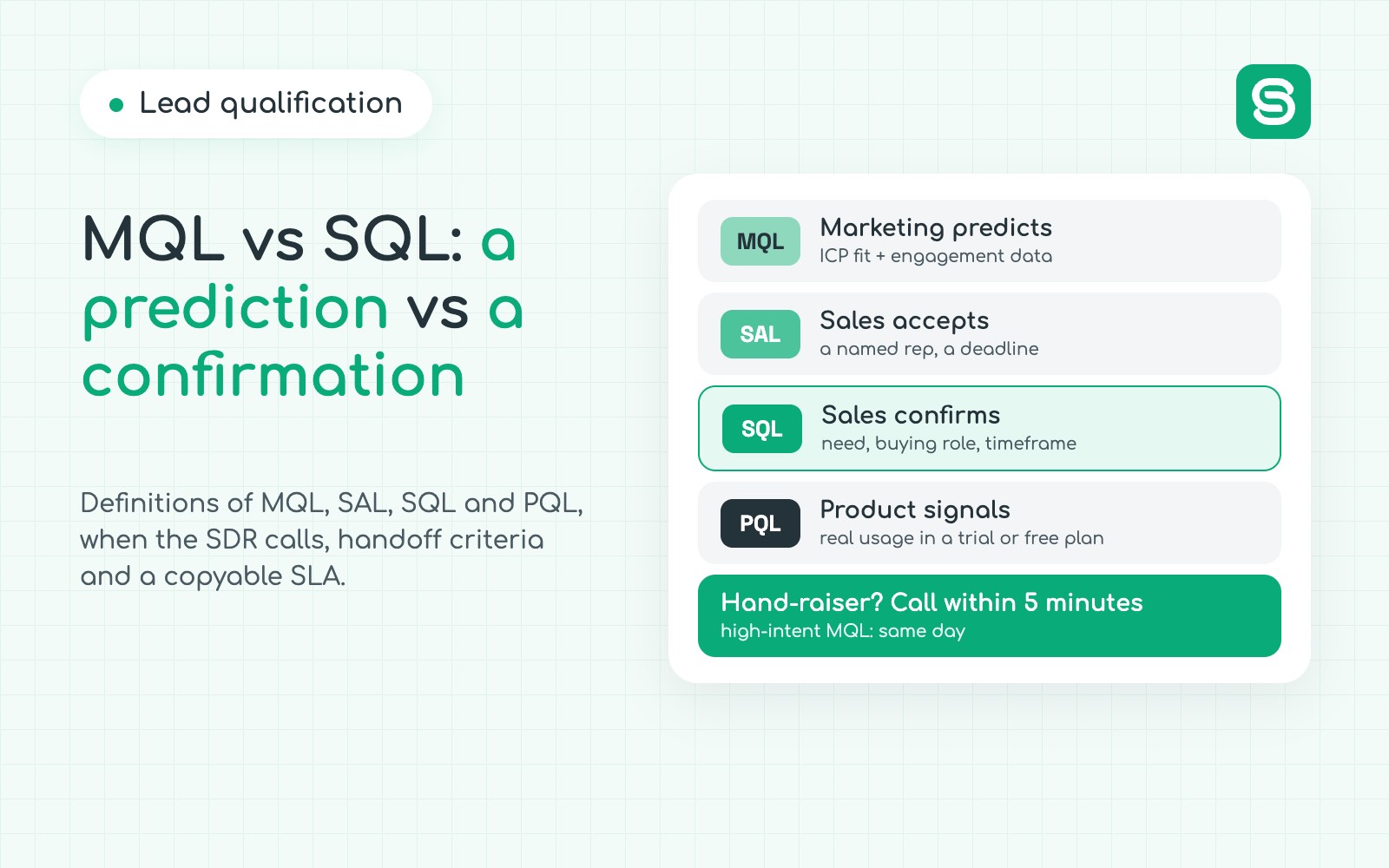
MQL vs SQL is the argument that happens every Monday in the pipeline review. Marketing says it sent 400 qualified leads last month. Sales says it got 400 names, maybe 30 worth calling. Both are telling the truth, because they’re using the same word, “qualified,” to mean two different things. Fix the definitions and the argument mostly goes away.
What is the difference between an MQL and an SQL?
The cleanest way to separate them is to ask who qualified the lead and how.
| Criterion | MQL | SQL |
|---|---|---|
| Who qualifies it | Marketing, usually through a scoring model | Sales, usually an SDR, confirmed by the AE |
| Based on | Data: firmographics, behavior, engagement | A live conversation with the prospect |
| What it proves | The lead looks like a buyer | The lead has a need, a buying role and a timeframe |
| Typical trigger | Score crosses a threshold, webinar plus pricing visit | Discovery meeting booked and accepted |
| What happens next | Routed to an SDR to work | Handed to an AE for discovery and an opportunity |
| Who is measured on it | Marketing (volume, cost per MQL) | SDRs (SQLs, meetings held) and marketing (pipeline sourced) |
In plain terms: an MQL is marketing raising its hand to say “this one looks good.” An SQL is sales coming back from the phone to say “yes, it is.” The first is a forecast, the second is a fact. Everything that goes wrong between marketing and sales comes from treating the forecast as if it were the fact.
If you want the full glossary of funnel and sales acronyms (MQL, SAL, SQL, SDR, BDR, AE, ICP), our cold calling and sales glossary defines each one.
What is an MQL?
A marketing qualified lead is a contact who matches your ideal customer profile and has engaged enough with your marketing to justify a salesperson’s attention. Two ingredients, both required:
The engagement alone is noise. The fit alone is a cold account. The MQL is the overlap. That’s why the strongest marketing teams build scoring in two separate dimensions and require a minimum on both, instead of adding everything into one number where 40 points of downloads can hide a terrible fit.
Common MQL triggers, from weakest to strongest
- 01
A gated content download.
The classic MQL, and the weakest. People download a guide to read a guide. On its own, it says very little about buying intent. - 02
Webinar or event attendance.
Better: they gave up an hour. Still mostly educational intent, unless the topic is close to your product. - 03
A tool or calculator used.
Someone who runs an ROI or cost calculator is sizing a problem. That’s a step closer to a budget conversation. - 04
Pricing, comparison or alternatives pages.
The visitor is evaluating vendors. Combined with ICP fit, this is the MQL that most deserves a same-day call. - 05
Several people from the same account.
When two or three people from one company engage in the same week, a buying group is forming. That’s an account signal, not a lead signal.
What an MQL is not
An MQL is not a demo request. Somebody who fills out “Talk to sales” has already qualified themselves on intent. Running that person through a scoring model, then a nurture email, then an SDR queue, is how companies lose deals they already had. Many teams still label these as MQLs for reporting, which is fine, as long as the routing treats them as hand-raisers. We come back to this in when to call.
What is an SAL, and why do most teams skip it?
The sales accepted lead is the most neglected stage in the funnel. An SAL is an MQL that sales has reviewed and agreed to work, usually within a set time window. Nobody has talked to the prospect yet. Sales has only said: “this lead is legitimate, it’s mine, I’ll work it.”
The stage names come from the demand waterfall that the research firm SiriusDecisions popularized in the 2000s: inquiry, MQL, SAL, SQL, then closed business. Forrester, which now owns SiriusDecisions, replaced its waterfall with an opportunity-centric model in 2021 (more on that below). The stage names stuck anyway, because every CRM report in America is built on them.
Here is the full sequence, with who owns each stage and the exit criterion that moves a lead forward. You can enlarge the diagram or download it.
Why bother with the SAL? Because without it, an MQL lands in a queue that no one owns. Marketing counts it as delivered, sales never touches it, and three weeks later it’s cold. The SAL creates a moment of accountability: a named rep, a timestamp, a deadline. It also gives you the most useful diagnostic in the funnel.
Small team: if you have one or two SDRs, you don’t need SAL as a separate CRM stage. A required “accepted” checkbox with a timestamp gives you the same accountability.
What is an SQL?
A sales qualified lead is a prospect that a salesperson has spoken with and confirmed meets your qualification criteria. The key word is spoken. An SQL requires a human conversation, on the phone or on a call booked by the prospect. Data can make a lead an MQL; only a conversation makes it an SQL.
What exactly the SDR has to confirm depends on your framework. Most B2B teams use a light version of one of these:
| Framework | What the SDR confirms before calling it an SQL | Best for |
|---|---|---|
| BANT | Budget, authority, need, timeline | Transactional and mid-market deals |
| GPCT | Goals, plans, challenges, timeline | Inbound-heavy teams selling to growing companies |
| CHAMP | Challenges, authority, money, prioritization | Teams that lead with the problem, not the budget |
| MEDDIC (light) | Pain and champion at SDR stage; the rest belongs to the AE | Enterprise deals with buying committees |
Our guides to BANT and GPCT go deep on each, and the lead qualification guide compares all of them. For the actual call, how to qualify leads on the phone gives a five-minute structure and the ten questions to have ready.
The SQL bar most teams should use
Don’t ask the SDR to fill out all four BANT letters on a first call. Prospects rarely disclose budget to someone they met three minutes ago, and forcing it turns the call into an interrogation. A practical SQL bar for most B2B teams has three parts:
A problem you solve, in their words
Not “we’re always looking to improve” but “our reps spend half their day on manual dialing.” If you can’t write the problem in one sentence in the CRM, it isn’t an SQL.
A buying role or a path to one
The person is the decision maker, or a strong influencer who agrees to bring the decision maker into the next meeting. “I’ll pass it along” doesn’t count.
A reason to act inside a window
A contract renewal, a new hire class, a quarter’s target, a board request. Without a timeframe, you have a nurture lead with a nice conversation attached.
The SQL becomes official when the account executive accepts the meeting. That acceptance step matters: if SDRs are paid on meetings booked and AEs aren’t asked to accept them, you’ll get a lot of SQLs nobody believes in. Our guide to the discovery call template covers what the AE does with the meeting once it lands.
Where do PQLs fit?
A product qualified lead is a user who reached a meaningful moment inside your product: invited teammates, connected an integration, hit a usage limit on a free plan, used a premium feature during a trial. PQLs only exist where people can use the product before talking to sales, so they matter mostly to product-led SaaS companies.
PQLs sit beside MQLs, not after them. The signal is different: an MQL consumed your content, a PQL used your product. That’s usually stronger evidence. But a PQL still needs a fit check (a freelancer on a free plan is rarely an enterprise buyer) and still needs a conversation to become an SQL.
- The signal is behavior inside the product, not content consumption.
- The user already understands what the product does.
- Usage data tells the SDR exactly what to talk about.
- Heavy usage from a tiny account looks great and buys nothing.
- One enthusiastic user isn’t a buying group.
- Teams over-automate PQL outreach and forget the call.
Some teams also use MQA (marketing qualified account): instead of scoring one person, they score the whole account and flag it when several people engage. We’ll come back to it in the section on whether the MQL is dead.
When should an SDR call an MQL?
This is the part most MQL vs SQL articles skip, and it’s the one that decides how many MQLs become SQLs. The answer isn’t one number. It depends on what kind of signal created the lead.
Hand-raisers: within five minutes
A demo request, a pricing request, a “call me back” form: these people asked to talk. The research on response time is old but consistent. The Lead Response Management Study run by InsideSales.com with MIT researcher James Oldroyd, presented in 2007 on data from six companies, found that the odds of contacting a lead “drop by 100 times” when the call comes after 30 minutes instead of 5, and the odds of qualifying it drop 21 times. That’s where the “five minutes” rule comes from. It measured contact and qualification, not closed deals, so treat it as a direction, not a promise.
Our speed to lead guide breaks down what each study really measured and how to set up routing that holds five minutes. To see how many deals slow callbacks cost you, the speed to lead calculator does the math.
High-intent MQLs: the same day
An account that fits your ICP and just spent four minutes on your pricing page is not ready to buy, but it is evaluating. Call the same day, and open with the reason you’re calling, not with a pitch: “I noticed your team has been looking at how we compare with your current dialer. Is that a project for this quarter?” Our guide to turning buying signals into a call list covers which signals justify a call and how to prioritize them.
Everything else: inside a sequence
A single ebook download from an ICP account deserves attention, not urgency. Put it in a sequence: a relevant email first, a call within two business days, a LinkedIn touch, then a second call. If a stronger signal fires while the lead is in the sequence, promote it to same-day calling.
Calling MQLs at volume
Once the rules are clear, the bottleneck becomes capacity. An SDR working 60 MQLs a day with manual dialing spends most of the day waiting on rings and voicemails. A power dialer chains the calls; a parallel dialer rings several numbers at once and connects the first person who answers. With Skipcall, voicemail detection drops a recorded message or sends an SMS automatically inside a sequence, and every call is logged back to HubSpot, Salesforce, Pipedrive or Attio so marketing can see what happened to each MQL. For the tagging side, our guide to call disposition codes gives a list you can map to your funnel stages.
How do you build lead scoring that sales trusts?
Most lead scoring models fail for the same reason: they’re built by marketing, in a spreadsheet, without the people who’ll call the leads. Sales then ignores the score, and the score becomes a vanity metric. Here’s a method that holds up.
Start from closed-won deals, not from opinions
Pull your last 50 to 100 closed-won deals and your last 50 closed-lost. Look at what the winning accounts had in common at the time they first engaged: size, industry, role of the first contact, which pages they visited. That’s your fit model.
Score fit and engagement separately
Two scores, not one. Fit from A to D, engagement from 1 to 4. An MQL requires a minimum on both, for example A or B fit and engagement of 3 or more. A D-fit lead never becomes an MQL, however engaged.
Add negative points and decay
Competitors, students, job seekers, personal email domains: negative. Engagement points should fade after 30 to 60 days, or last year’s webinar attendee stays an MQL forever.
Route hand-raisers around the model
Demo, pricing and callback requests from an ICP fit go straight to an SDR. They don’t wait for a score.
Review with sales every month
Look at MQLs sales rejected and SQLs that came from leads scored low. Adjust one rule at a time.
To build the fit side quickly, our ICP lead scoring tool turns your ideal customer criteria into a weighted score. For the conversation side, the sales qualification scorecard gives SDRs a consistent grid.
A scoring grid to copy
Two-axis lead scoring grid (fit x engagement)
Template written for this article. Replace the examples with what your closed-won data shows.
FIT SCORE (who they are)
A = all core criteria: [industry], [50 to 1,000 employees], [US or Canada], [title: VP or Director of Sales / RevOps / Sales Ops]
B = 3 of 4 core criteria
C = 2 of 4 core criteria
D = 1 or 0, or a disqualifier (competitor, student, job seeker, agency reselling)

ENGAGEMENT SCORE (what they did, last 45 days)
+30  pricing, comparison or alternatives page visit
+25  ROI or cost calculator used
+20  webinar attended (live, not registered only)
+15  second person from the same account engaged
+10  case study read
+5   blog visit (max 15 points from blog)
+5   content download
-20  no activity in 30 days (decay)
Engagement level: 1 = under 20 | 2 = 20 to 39 | 3 = 40 to 59 | 4 = 60+

MQL RULE
MQL = fit A or B AND engagement 3 or 4
Hand-raiser (demo, pricing, callback request) with fit A, B or C = route to SDR immediately, skip scoring
Fit D = never MQL, whatever the engagement
What should a marketing and sales SLA say?
A service level agreement is a short written contract between marketing and sales. Marketing commits to a volume and a definition; sales commits to a response time and a follow-up effort. Without it, every MQL dispute is a matter of opinion.
The SLA doesn’t need to be long. It needs to answer five questions: what is an MQL, how many will marketing deliver, how fast does sales respond, how hard does sales try, and what happens to leads that don’t convert.
Marketing and sales SLA (one page)
Template written for this article. Fill in the brackets, review every quarter.
MARKETING AND SALES SLA, [Quarter, Year]

1. DEFINITIONS
MQL: fit A or B AND engagement 3 or 4 (see scoring grid), OR a hand-raiser (demo, pricing, callback request) with fit A to C.
SAL: an MQL an SDR has accepted in the CRM.
SQL: a lead with a confirmed problem, buying role and timeframe, and a discovery meeting the AE has accepted.

2. MARKETING COMMITS TO
[number] MQLs per month, of which at least [number] hand-raisers.
Every MQL has: name, company, title, direct phone or mobile when available, lead source, the trigger that created it.

3. SALES COMMITS TO
Hand-raisers: first call attempt within 5 minutes during calling hours ([8 AM to 6 PM] in the lead's time zone).
Other MQLs: accepted or rejected within [4] business hours, first call within [2] business days.
Minimum effort before recycling: [6] attempts over [10] business days, at least [3] calls.
Rejected MQLs: a reason picked from the list (bad fit, bad data, duplicate, competitor, student or job seeker).

4. RECYCLING
Not reached or not ready: back to marketing nurture with the reason logged.
Re-enters as MQL only on a new, stronger signal.

5. REVIEW
Monthly 30-minute review: MQL to SAL, SAL to SQL, SQL to opportunity, by lead source.
Owner: [RevOps name]. Escalation: [VP Marketing] and [VP Sales].
Marketing promises a definition and a volume. Sales promises a response time and an effort. Everything else is commentary.
The recycle rule is the part everyone forgets
Most MQLs will not become SQLs. That’s normal. What matters is where they go. Without a recycle rule, unconverted leads stay assigned to an SDR who stopped calling them weeks ago. With one, they go back to marketing with a reason (“not reached after 6 attempts,” “no project before Q3”), and marketing can nurture them until a new signal brings them back. A lead that says “call me in September” is not a failure. It’s a future SQL with a date.
What is a good MQL to SQL conversion rate?
There’s no audited, industry-wide benchmark. Every published figure comes from an agency or a vendor summarizing its own clients, with its own definitions. The most detailed public dataset is First Page Sage’s, an SEO and lead generation agency that publishes MQL to SQL conversion rates by industry from client data gathered from 2019 through November 2026.
| Lead source (2026) | Average MQL to SQL rate |
|---|---|
| Referrals | 27% |
| Events and trade shows | 21% |
| Webinars | 19% |
| SEO (organic search) | 18% |
| Email marketing | 16% |
| LinkedIn (organic) | 14% |
| PPC (Google Ads) | 13% |
| Paid social | 9% |
Read these numbers with their definition in mind. First Page Sage counts as an MQL a contact who has shown intent to buy (a contact form, an email to sales) and can afford the product. That’s much closer to a hand-raiser than the “downloaded an ebook” MQL many teams use. If your MQL definition is looser, expect a lower rate; if you only count demo requests, expect a higher one. The source ranking is the most useful part: it tells you which channels to judge on a different bar.
What you can do is measure your own rate properly, then improve it.
- 01
Measure by lead source.
Demo requests, webinars, content, paid social, events. A blended rate hides everything. Hand-raisers and content downloads shouldn’t even be in the same report. - 02
Use cohorts, not monthly snapshots.
Count the MQLs created in March and how many became SQLs within 60 or 90 days. Comparing March MQLs with March SQLs mixes different leads. - 03
Track the two halves separately.
MQL to SAL tells you about lead quality. SAL to SQL tells you about sales follow-up. One blended rate can’t tell you which side to fix. - 04
Set a target after three months.
Once you have a baseline per source, aim to improve the weakest source first. It’s usually the one with the loosest definition.
What is one MQL worth?
The conversion rate becomes much more interesting once you turn it into dollars. Change the numbers below to your own; the default values are an example.
What is one MQL worth to you?
Default numbers are an example, not a benchmark. Raise the MQL to SQL rate by 5 points and watch what each MQL becomes worth.
That’s the business case for fixing response time and SDR capacity before buying more leads. To model the full funnel from first touch to closed deal, use our sales funnel calculator. Once the deals are in, our article on close rate explains how to calculate and benchmark the last step.
What drags the rate down
Is the MQL dead?
You’ll read that a lot. There’s something real behind it.
In 2021, Forrester, which had acquired SiriusDecisions (the firm behind the original demand waterfall), launched the B2B Revenue Waterfall, built around buying groups and opportunities instead of individual leads. The reasoning: B2B purchases are made by groups of people, and scoring one person who downloaded a PDF misses the group that’s actually deciding.
Buyer behavior points the same way. A Gartner survey of 632 B2B buyers, published in June 2025, found that 61% prefer a rep-free buying experience overall, and 73% actively avoid suppliers who send irrelevant outreach. And the 6sense data above says buyers reach out late, with a favorite already in mind: 92% of eventual winners were on the initial shortlist.
So is the MQL dead? Not quite. What’s dying is the MQL as a volume target: marketing paid to produce as many as possible, regardless of whether sales can do anything with them. What’s replacing it is a mix of three things:
The practical consequence for SDRs: when an account lights up, call more than one person. Our guide to multithreading in sales shows how to reach the rest of the buying group without annoying the person who raised their hand first. And if your company relies mostly on inbound, read our comparison of inbound vs outbound sales: when buyers arrive with a favorite already picked, outbound is often how you get onto the shortlist in the first place.
The mistakes that break the MQL to SQL handoff
For the day-to-day of the people working these leads, see our guides to the SDR role and responsibilities and to SDR vs BDR, which explains why many companies split inbound MQL follow-up and outbound prospecting into two jobs.
Key takeaways
Sources
- InsideSales.com and MIT: Lead Response Management Study (2007, PDF)
- 6sense via Business Wire: 2026 Global B2B Buyer Experience Report findings (November 2, 2026)
- First Page Sage: MQL to SQL Conversion Rate by Industry, 2026 report (updated November 19, 2026)
- Gartner: Sales survey finds 61% of B2B buyers prefer a rep-free buying experience (June 25, 2025)
- Forrester: Forrester debuts next-generation B2B Revenue Waterfall




