Your SDR spent 40 dials, two voicemails and a gatekeeper to book a 30-minute demo with a VP of Operations in Columbus. On Thursday at 2:00 PM, the AE sits alone in the Zoom room, refreshes, waits, and logs a no-show. The fix most teams reach for is a reminder. The fix that actually works is a short sequence of appointment reminder texts, written like a person, timed to the prospect’s day, and easy to answer.
Why do prospects no-show, and do reminder texts help?
A booked meeting is a promise made on a busy day, often in the last minute of a cold call. By the time the meeting comes around, the prospect has had dozens of other meetings, the calendar invite has slid under a stack of others, and the reason they said yes is fuzzy. Most no-shows aren’t rejections. They’re forgetting, a conflict that came up, or a meeting that no longer feels worth the time.
What the research shows
The best evidence on reminders doesn’t come from sales. It comes from healthcare, where missed appointments are expensive and have been studied for decades with randomized trials. Two findings carry over well.
The Cochrane review of mobile phone messaging reminders pooled randomized controlled trials and found moderate-quality evidence that text reminders improved attendance compared with no reminder, with a risk ratio of 1.14: roughly 14% more people showing up. Texts did about as well as phone call reminders, and in the two studies that measured cost, cost per attendance was 55% and 65% lower than with phone calls.
The second finding is about why people miss. A systematic review of 105 studies in Health Policy put the average no-show rate around 23% and found that the most commonly reported significant predictors were high lead time (a long gap between booking and appointment) and prior no-show history. Both translate directly to sales: a demo booked three weeks out is at risk, and a prospect who skipped once is likely to skip again.
What we know about B2B meetings
For sales meetings, there’s no peer-reviewed benchmark, and published figures come from vendors selling scheduling or demo tools. Treat them as directional. In a Chili Piper guide by Will Aitken, the scheduling vendor calls 20% “the standard no-show rate in sales” and says automated reminders, one the day before and one the day of, helped it reach an outbound no-show rate under 5%. Its guide to handling no-shows also recommends booking meetings within 14 days and keeping them to 30 minutes.
The first lever is upstream. A meeting booked by an SDR who rushed the close, never confirmed the pain and pushed for “any time next week” is weaker than one booked after a real conversation. Our cold call follow-up guide covers how to end a call with a meeting that sticks, and the discovery call template shows what the meeting itself should deliver so the next one gets booked too.
When should you send appointment reminder texts?
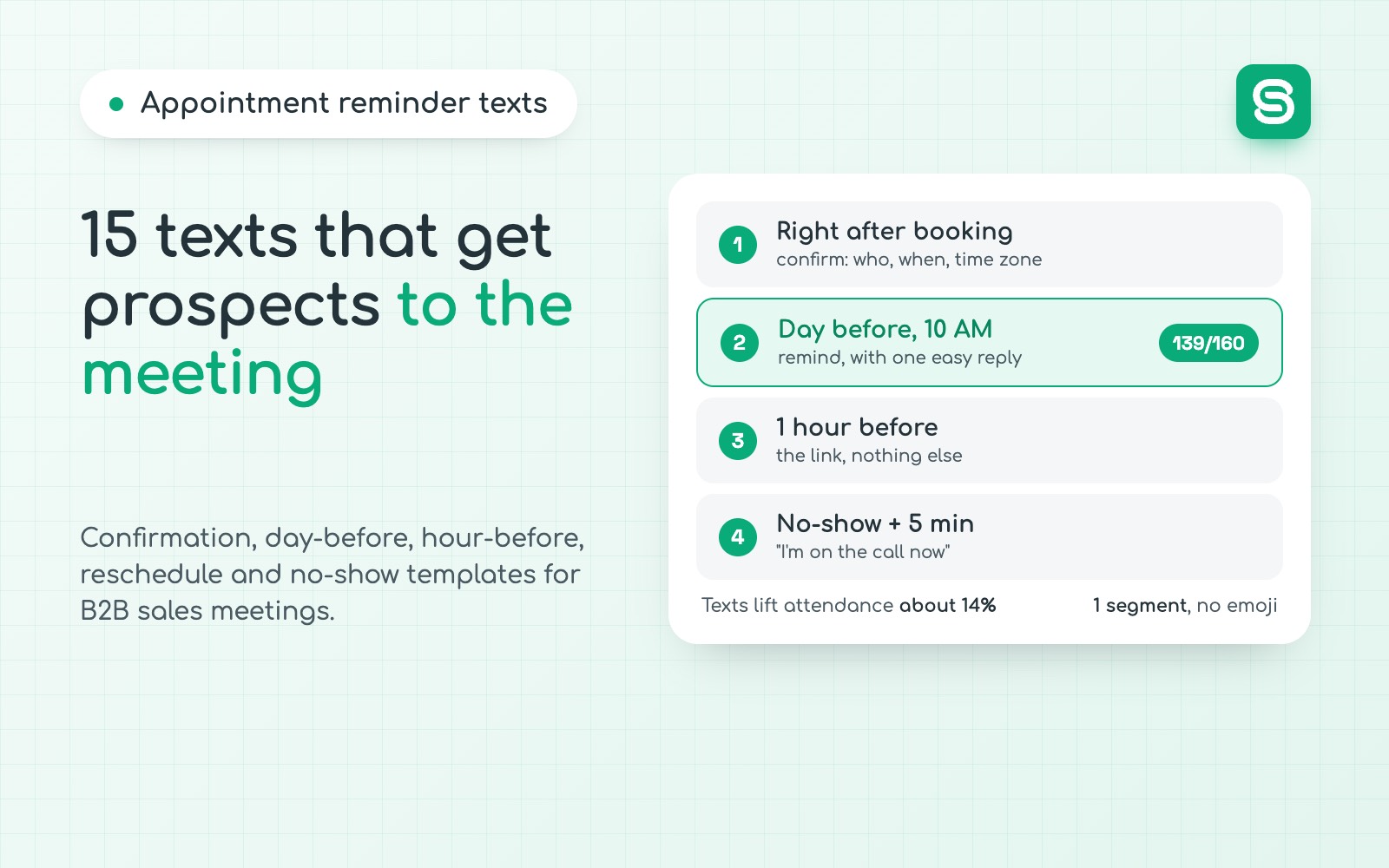
The timing below is written for a typical B2B meeting booked by an SDR or through a demo form. It’s built on the two findings above (reminders help, long gaps hurt) and on how buyers actually read their phones during a workday. You can enlarge the timeline or download it.
- 01
Right after booking: confirm.
Within five minutes of hanging up or of the form submission. The prospect still remembers saying yes, and a reply now is a second, written commitment. - 02
The day before, mid-morning: remind.
Between 9 and 11 AM in the prospect’s time zone. Late enough that they’re at their desk, early enough to move the meeting without stress. Avoid evenings: a work reminder at 8:30 PM reads as intrusive. - 03
One hour before: nudge.
Just the link or the number. For a phone call, send it 15 minutes before instead, so the prospect expects your number to ring and picks up. - 04
Start time plus five minutes: I'm on the call.
One neutral text with the link again. Many “no-shows” are people stuck in the previous meeting. - 05
Same afternoon: offer two new slots.
Specific options make rebooking a one-word reply. Add a booking link as a fallback. - 06
After a second miss: close the loop.
One polite last text, then stop. The prospect knows where to find you.
Adjust for how far out the meeting is
| Booked | Texts to send | Why |
|---|---|---|
| Same day | Confirmation, then the 1-hour nudge | A day-before text makes no sense; keep it short |
| 1 to 7 days out | Confirmation, day-before, 1-hour | The standard sequence |
| 8 to 14 days out | Confirmation that says you will check in, day-before, 1-hour | Lead time raises no-show risk; the check-in is announced, not a surprise |
| More than 14 days out | Try to book sooner. If not: a useful touch midway, then the standard sequence | Interest fades; send a relevant resource, not a "just checking in" |
Time zones: schedule every text in the prospect’s local time, using their area code or company address, never yours. A rep in New York texting a Seattle prospect “see you in an hour” at 8 AM Eastern has just sent a 5 AM text.
For more on reaching people at the right moment, our best time to cold call data breaks answer rates down by hour and day, and the when to call tool converts a prospect’s location into your local calling window.
What makes a good meeting reminder text?
A reminder has one job: get the prospect to the meeting, or get them to move it instead of skipping it. Everything that doesn’t serve that job comes out. Here’s the structure every template below follows.
A good reminder makes rescheduling easier than skipping.
Three things don’t belong in a reminder: a pitch (“and don’t forget our holiday pricing!”), pressure (“I’ve blocked this time especially for you”), and links to anything except the meeting. A pitch also changes the legal nature of the message, as you’ll see in the compliance section.
Before using the templates, replace every bracket. The character counts given with each template were measured with sample values (a 7-letter first name, a 10-letter company, a 28-character meeting link). Long names or links can push a text past 160 characters; paste your final version into our SMS character counter to check.
Sales meeting confirmation texts
Send these within five minutes of booking. The confirmation is the most important text in the sequence: it lands while the prospect still remembers why they said yes, and it’s where a reply is most likely. These three also have room for an opt-out line and still fit one segment.
#1 Confirmation after booking on a cold call
112 characters with sample values. Send right after hanging up.
Hi [First name], [Your name] from [Company]. Confirming [day] at [time] [time zone], invite sent. Reply here if anything changes.
#2 Confirmation after an inbound demo request
123 characters with sample values. The question earns a reply and helps you prep.
Hi [First name], [Your name] at [Company]. I'll run your demo [day] at [time] [time zone]. What's the one thing you want to see? Reply here.
#3 Confirmation for a meeting more than a week out
123 characters with sample values. Announces the check-in so the day-before text isn't a surprise.
Hi [First name], [Your name] from [Company]. We're set for [date] at [time] [time zone]. I'll text the day before to check it still works.
Day-before reminder texts
Send between 9 and 11 AM in the prospect’s time zone. This is the text that recovers the “I forgot” and “something came up” no-shows, provided it makes moving the meeting easy.
#4 Standard day-before reminder
139 characters with sample values.
Hi [First name], reminder: [Company] call tomorrow at [time] [time zone] with [Your name]. Link is in the invite. Still good? Reply YES or suggest a new time.
#5 Day-before reminder with the agenda
151 characters with sample values. Reminds the prospect what they get out of the meeting.
Hi [First name], for tomorrow at [time]: your current [process], a 10-min look at [topic], then next steps. Anything to add? [Your name], [Company]
#6 Day-before reminder for a meeting with several stakeholders
146 characters with sample values. Multithreads the deal and makes the meeting harder to drop.
Hi [First name], looking forward to tomorrow at [time] [time zone]. Is anyone else joining from [their company]? Happy to add them to the invite. [Your name], [Company]
Template #6 does double duty. Asking who else should join is a reminder, a qualification question and a way to get a second name on the deal. A meeting with two people from the account on the invite is harder to cancel quietly than a one-on-one.
Hour-before reminder texts
Short and practical. At this point the prospect doesn’t need persuading, they need the link or a heads-up that your number is about to ring.
#7 One hour before a video call
91 characters with sample values. Paste the full link, not a shortened one.
Hi [First name], see you at [time] [time zone]. Join here: [link] [Your name], [Company]
#8 Fifteen minutes before a phone call
126 characters with sample values. Sent from the number you'll call from, so they recognize it.
Hi [First name], [Your name] from [Company]. I'll call you at [time] [time zone] on this number. If another number is better, just reply with it.
#9 One hour before an on-site meeting
147 characters with sample values.
Hi [First name], [Your name] from [Company]. On track for [time] at your [city] office, I'll check in at the front desk. This is my cell if anything changes.
Template #8 matters more than it looks. Many prospects don’t answer unknown numbers, and phones increasingly screen or silence them; our guide to iPhone call screening explains what that does to sales calls. A text from the same number 15 minutes earlier turns your call from “unknown” into “expected.” If you call from a different number than you text from, you lose that effect.
Reschedule texts
Meetings move. The goal is to move them in one exchange instead of five, which means offering specific options rather than “when works for you?”
#10 You need to move the meeting
142 characters with sample values. Offer two slots; never make the prospect do the work.
Hi [First name], [Your name] from [Company]. Something came up on my side for [day] at [time], my apologies. Would [option 1] or [option 2] work instead?
#11 The prospect asks to move it
114 characters with sample values. Reply fast and make it easy.
No problem, [First name]. Would [option 1] or [option 2] [time zone] work? Or pick any slot here: [link] [Your name]
#12 You're running late
108 characters with sample values. Send it before the start time, not after.
Hi [First name], [Your name] here. Running 5 minutes late for our [time] call, sorry about that. I'll be on by [new time].
No-show follow-up texts
The prospect didn’t join. Stay neutral: assume a real reason, because there usually is one, and make coming back easy. Three texts, then stop.
#13 Five minutes after the start
120 characters with sample values. One text, not three.
Hi [First name], I'm on the call now: [link] Running late? No problem, I'll stay on until [time + 15 min]. [Your name]
#14 Same afternoon: offer two new slots
138 characters with sample values.
Hi [First name], sorry we missed each other today. [option 1] or [option 2] instead? Or pick a slot: [link] [Your name], [Company]
#15 After a second no-show: close the loop
140 characters with sample values. Polite, final, door open.
Hi [First name], we've missed each other twice, so I'll stop chasing. If [topic] becomes a priority, just reply here. [Your name], [Company]
Template #15 often gets the best reply rate of the three, because it removes the pressure. Some prospects answer it with the real reason (a reorg, a frozen budget, a project pushed to Q2), which is worth more for your forecast than another unanswered reminder. Record that reason with a clear outcome code; our call disposition codes guide proposes a list that separates “no-show” from “not now.”
Call or text after a no-show?
- The prospect is probably still in another meeting.
- You’ve never spoken live, and the meeting came from a form.
- You want to give them an easy, low-pressure way back.
- It’s the five-minute “I’m on the call” message.
- The meeting was a late-stage step (proposal review, contract).
- Several people from the account were supposed to attend.
- They didn’t answer the same-day text by the next morning.
- You suspect something changed on their side and want to hear it.
If you call, prepare 30 seconds before you dial: our guide to calling a prospect back has the scripts. If you get voicemail, keep it short and point to the text you just sent; the B2B voicemail scripts include a no-show version.
How long should a reminder text be?
Under 160 characters, with no emojis and no curly quotes. Here’s why that specific number matters, according to Twilio’s documentation on SMS character limits.
| Encoding | One segment | Per segment when split |
|---|---|---|
| GSM-7 (plain letters, digits, basic punctuation) | 160 characters | 153 characters |
| UCS-2 (any emoji, curly quote or special character) | 70 characters | 67 characters |
A longer message is split into segments and reassembled on the phone, but each segment is billed. Twilio’s US SMS pricing lists $0.0083 per outbound segment on a 10-digit long code, before carrier fees. The trap isn’t length, it’s encoding: one curly apostrophe pasted from a word processor, or one emoji, switches the whole message to UCS-2. Our 139-character day-before reminder then becomes three segments instead of one, and some phones display it oddly.
Write templates in a plain-text editor, use straight apostrophes, and test the final version in the SMS character counter, which shows encoding and segment count as you type.
Are appointment reminder texts legal? TCPA and 10DLC rules
Short answer: yes, when they’re sent to a number the prospect gave you, about a meeting they agreed to, with no sales pitch, and you stop when asked. Here are the rules that frame that answer in the US. This section is general information, not legal advice.
- 01
Texts are calls under the TCPA.
The Telephone Consumer Protection Act applies to text messages to cell phones. Automated marketing texts need prior express written consent. Informational texts, like a reminder for a meeting the person scheduled, sit in a different category, but they still need the person’s permission to be texted, and they lose that status if you add promotional content. Our guide to cold calling cell phones in B2B explains why “it’s a business contact” doesn’t remove the cell phone rules. - 02
A meeting reminder isn't a telephone solicitation.
Under the FCC’s TCPA rules at 47 CFR 64.1200, a “telephone solicitation” excludes messages sent with the person’s prior express invitation or permission. That’s what a confirmed meeting is. The solicitation rules (the Do Not Call Registry, and the 8 AM to 9 PM calling window in the recipient’s local time) target sales messages; keep reminders inside that window anyway. - 03
Opt-out words are defined.
The same rules list “stop,” “quit,” “end,” “revoke,” “opt out,” “cancel” and “unsubscribe,” sent in reply to a text, as reasonable ways to revoke consent, and any reply that clearly means stop counts too. Your whole team must honor them, whatever number the reply came to. The FCC’s revocation changes taking effect on November 25, 2026 are covered in our TCPA rule changes guide. - 04
10DLC registration is the carriers' rule.
Business texts sent from 10-digit numbers through a messaging provider must be registered with US carriers (brand and campaign) under A2P 10DLC, or they risk being filtered or blocked. Registration, costs and approval times are in our A2P 10DLC guide. - 05
States can be stricter.
Several states have their own telemarketing laws, some covering texts. Florida, for example, limits commercial solicitation calls to 8 AM to 8 PM. Reminders aren’t solicitations, but if your texts drift into selling, state rules apply. Start with is cold calling legal in the US? for the state picture.
A compliance checklist for your reminder texts
Reminder text compliance checklist (US)
Checklist written for this article. General information, not legal advice.
[ ] The prospect gave us this number and agreed to a meeting (noted in the CRM).
[ ] We asked "Can I text you the details?" or the booking form says we will text.
[ ] The text is about the meeting only: no offer, no discount, no unrelated link.
[ ] It says who we are (first name + company) in the first line.
[ ] Sent between 8 AM and 9 PM in the recipient's local time (we aim for business hours).
[ ] The first text in the thread carries an opt-out line: "Reply STOP to opt out."
[ ] STOP, QUIT, END, REVOKE, OPT OUT, CANCEL, UNSUBSCRIBE, or any clear "stop," ends all texts from the whole team.
[ ] Our sending numbers are registered for A2P 10DLC with our provider.
[ ] Texts go out from the same number the rep calls from.
[ ] The number was checked against our internal do-not-contact list.
That last line connects to your calling process: a prospect who told your SDR “don’t call me” in March shouldn’t get a reminder from your AE in May. Our guide to DNC scrubbing covers how to keep those lists in sync.
How to measure your no-show rate
You can’t improve what you don’t count, and most CRMs don’t count no-shows cleanly by default: the meeting either gets deleted, rescheduled in place (erasing the miss) or left as “completed.” Fix the logging first.
Log every outcome
Every booked meeting ends as held, rescheduled by the prospect, rescheduled by us, canceled, or no-show. Never edit the original meeting to the new date; create a new one so the miss stays visible.
Take a baseline
No-show rate = no-shows divided by meetings that were supposed to happen that month. Split it by booking source (cold call, inbound form, event, referral) and by lead time.
Change one thing
Add the confirmation text, or the day-before text, or the five-minute text. One change at a time, or you won’t know what worked.
Compare and keep
Compare the same sources month over month. Keep what moves the number and track show rate next to meetings booked in your weekly SDR review.
Show rate belongs in your SDR scorecard: a rep who books 20 meetings with a 35% no-show rate creates less pipeline than one who books 16 at 10%. Our SDR metrics and KPIs guide puts it next to the other activity metrics, and the cost per meeting calculator shows what each held meeting really costs you. To see how many no-shows are costing you in pipeline, run your numbers below.
No-show cost calculator
Example values built for this article. Replace them with last quarter's numbers.
- Meetings lost per month
- 8
- Meetings recovered per year
- 38
- Pipeline recovered per year
- $57,600
Sending reminder texts from your calling number
The most effective reminder comes from the number the prospect already associates with you: the one that called them to book the meeting. A text from a random short code or an unrelated sender breaks that link and reads like a notification.
In Skipcall, SMS messaging is two-way and goes out from the same number your rep calls from. Replies land in a shared team inbox, with the exchange attached to the contact’s history next to calls and transcripts, and a “Call” button turns a reply into a call in one click. It’s built for one-to-one texts written by your reps: Skipcall doesn’t run SMS campaigns or bulk sends, so reps send the day-before and hour-before texts themselves, from templates like the ones above.
The most common reminder mistakes
Key takeaways
Sources
- Gurol-Urganci et al., Mobile phone messaging reminders for attendance at healthcare appointments, Cochrane Database of Systematic Reviews, 2013 (PubMed)
- Dantas et al., No-shows in appointment scheduling: a systematic literature review, Health Policy, 2018 (PubMed)
- Electronic Code of Federal Regulations: 47 CFR 64.1200, delivery restrictions (TCPA rules)
- Twilio: What is the SMS character limit?
- Twilio: SMS pricing, United States
- Chili Piper: Will Aitken’s guide to no-shows
- Chili Piper: How to handle no-shows




