Ask five sales leaders which sales methodology they run and you’ll hear five acronyms: “We’re a MEDDPICC shop.” “We trained everyone on Challenger.” “BANT, but loosely.” Then listen to their reps’ calls and you’ll often hear the same thing everywhere: a pitch, a demo request, and a deal that dies in “no decision.” The acronym isn’t the problem. Choosing one that fits your deals, and actually using it on calls, is.
What is a sales methodology?
A sales methodology is a shared, written answer to the question “how do we sell here?” It tells a rep which questions to ask on a first call, what to listen for, how to frame the value of the product, and what has to be true before a deal can be forecast. It gives managers a common language to coach with: “Who’s your champion?” means the same thing to every account executive on the floor.
Without one, every rep sells their own way. That works when you have three reps who all came from the same company. It stops working when you hire your tenth, because you can’t coach what you can’t name, and you can’t forecast deals that every rep qualifies differently.
The case for structure has grown with buyer complexity. Gartner reports that B2B buyers spend only 24% of their buying time meeting with all potential suppliers, your competitors included. In a separate survey of more than 250 B2B customers, Gartner found that 77% rated their purchase experience as extremely complex or difficult, with a typical buying group of six to 10 stakeholders. When you get a small slice of a messy process, every conversation has to count. A methodology is how you make each one count on purpose instead of by luck.
Sales process vs. sales methodology vs. qualification framework
These three terms get used interchangeably, and that confusion is behind many failed rollouts. Here’s how they differ.
| Term | What it is | Example |
|---|---|---|
| Sales process | The stages a deal moves through, with exit criteria for each | Lead, discovery, demo, proposal, negotiation, closed won |
| Sales methodology | How reps think and behave inside those stages | Challenger: teach, tailor, take control |
| Qualification framework | A checklist that decides whether a deal is real | BANT: budget, authority, need, timeline |
| Sales playbook | The written kit: scripts, questions, battle cards, examples | Your team wiki or enablement tool |
The practical consequence: you can’t “switch from BANT to Challenger,” because they don’t do the same job. BANT tells you whether to keep talking to someone; Challenger tells you what to say once you are. A qualification framework is one kind of methodology, a narrow one. Our complete lead qualification guide covers that narrow layer in depth; this article looks at the whole map.
The process tells you where a deal is. The methodology tells the rep what to do to move it.
What are the main types of sales methodologies?
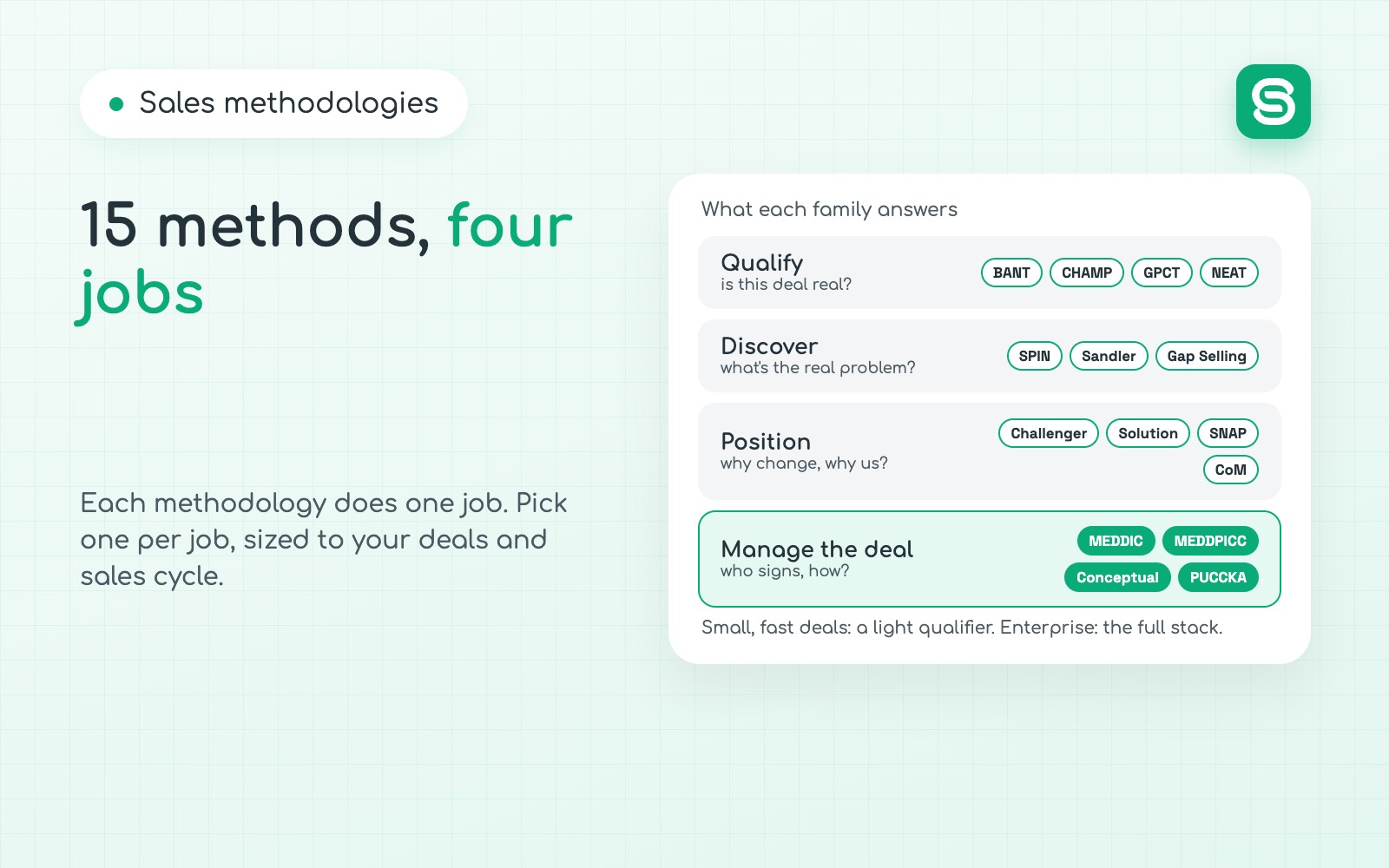
Most lists of “the top sales methodologies” put fifteen acronyms in one long ranking, as if they competed. They mostly don’t. Each one was built to fix a specific failure: deals that weren’t real, discovery that stayed on the surface, pitches that sounded like everyone else’s, or late-stage deals that died in procurement. Sort them by the failure they fix and you get four families.
Read the rest of this guide with that grid in mind. When someone asks “BANT or MEDDIC?”, the real question is “how much deal-management rigor do our deals need?” Our BANT vs. MEDDIC comparison answers exactly that, and SPIN vs. MEDDIC shows why a discovery method and a deal framework stack instead of competing.
Sales methodology examples: 15 methods compared
Here is each methodology in one card: where it comes from, the core idea, when it shines and where it breaks. Where we have a full guide, the link follows each group of cards.
Qualification frameworks: is this deal real?
BANT
- Origin
- IBM, decades ago; the oldest framework still in daily use
- Core idea
- Budget, Authority, Need, Timeline: four boxes to check before investing time
- Best for
- Transactional deals, inbound triage, SDR handoff criteria
- Breaks when
- The buyer hasn't budgeted for a category they don't know yet
CHAMP
- Origin
- A BANT reorder that spread through SaaS sales teams
- Core idea
- Challenges, Authority, Money, Prioritization: lead with the problem, not the budget
- Best for
- Cold outbound, where asking about budget first ends the call
- Breaks when
- Many stakeholders: one authority box is not enough
GPCT
- Origin
- HubSpot's inbound sales methodology
- Core idea
- Goals, Plans, Challenges, Timeline: start from what the buyer is trying to achieve
- Best for
- Inbound leads who already raised a hand
- Breaks when
- Used alone on cold calls: buyers won't share plans with a stranger
NEAT
- Origin
- Richard Harris (The Harris Consulting Group) with the Sales Hacker community
- Core idea
- Need, Economic impact, Access to authority, Timeline (compelling event)
- Best for
- SaaS teams that want BANT's speed with a business case
- Breaks when
- Reps can't quantify impact, so the E stays empty
Full guides: BANT framework, CHAMP, GPCT and NEAT Selling. If your reps qualify mostly by phone, how to qualify leads on the phone in 5 minutes turns these frameworks into a call structure.
Discovery methods: what is the real problem?
SPIN Selling
- Origin
- Neil Rackham and Huthwaite, book published in 1988; 35,000 B2B sales interactions observed (Huthwaite)
- Core idea
- Situation, Problem, Implication, Need-payoff questions, in that order
- Best for
- Larger sales where the buyer must feel the cost of the problem
- Breaks when
- Reps over-ask situation questions and interrogate the buyer
Sandler
- Origin
- David Sandler, Sandler Selling System, founded in 1967
- Core idea
- Up-front contracts, the pain funnel, disqualify early, the buyer does the convincing
- Best for
- Teams wasting time on prospects who were never going to buy
- Breaks when
- Reps copy the techniques without the respect, and sound manipulative
Gap Selling
- Origin
- Keenan (A Sales Growth Company), from his book Gap Selling
- Core idea
- Map the current state and the future state; the gap between them is what you sell
- Best for
- Problem-centric SaaS and services sales, mid-market
- Breaks when
- The rep can't credibly describe the buyer's current state
SPIN came out of Neil Rackham’s field research: Huthwaite says his team observed 35,000 business-to-business sales interactions to see how successful sellers question buyers, which is still why it’s the method most teams reach for when discovery feels thin. Full guides: SPIN Selling and the Sandler pain funnel. To turn any of these into actual questions, see our 30 cold call discovery questions and the discovery call template.
Positioning methods: why change, why now, why us?
Challenger Sale
- Origin
- Matthew Dixon and Brent Adamson, CEB (now Gartner), book published in 2011
- Core idea
- Teach the buyer something new, tailor it to each stakeholder, take control of the process
- Best for
- Complex sales where buyers think they already know the answer
- Breaks when
- The insight is generic, or the rep confuses challenging with arguing
Solution Selling
- Origin
- Mike Bosworth, developed from the 1980s
- Core idea
- Diagnose pain, then sell the product as the solution to that pain, not as features
- Best for
- Configurable products and services with a real diagnosis phase
- Breaks when
- Buyers arrive pre-informed and only want a price
SNAP Selling
- Origin
- Jill Konrath, book published in 2010
- Core idea
- Keep it Simple, be iNvaluable, always Aligned, raise Priorities
- Best for
- Selling to overloaded executives who give you two minutes
- Breaks when
- The deal needs deep discovery the buyer won't make time for
Command of the Message
- Origin
- Force Management's value-messaging methodology
- Core idea
- Tie required capabilities to positive business outcomes and proof of differentiation
- Best for
- Scaling teams that need one consistent value story
- Breaks when
- Marketing builds the framework and sales never uses it on calls
Command of the Message is a proprietary program: Force Management builds a value framework with each client rather than handing over a fixed script. Full guide: the Challenger Sale. Positioning also includes how you handle competitors once a buyer names one; our sales battle cards guide gives you a phone-ready template.
Deal-management frameworks: who signs, how, against whom?
MEDDIC
- Origin
- PTC (Parametric Technology), mid-1990s
- Core idea
- Metrics, Economic buyer, Decision criteria, Decision process, Identify pain, Champion
- Best for
- Enterprise deals and forecast accuracy
- Breaks when
- Applied to small deals, where it turns into CRM paperwork
MEDDPICC
- Origin
- An extension of MEDDIC adopted by enterprise SaaS teams
- Core idea
- MEDDIC plus Paper process and Competition
- Best for
- Large deals with procurement, legal and security reviews
- Breaks when
- Reps fill fields from memory instead of from the buyer's words
Conceptual Selling
- Origin
- Robert Miller and Stephen Heiman (Miller Heiman), 1980s
- Core idea
- Buyers purchase their concept of a solution; find it before presenting yours
- Best for
- Consultative deals with several influencers who each see it differently
- Breaks when
- Fast cycles: the method is deliberately slow
PUCCKA
- Origin
- Mark Suster, investor and former founder
- Core idea
- Pain, USP, Compelling event, Champion, Key players, Aligned purchase
- Best for
- Enterprise teams that want MEDDIC's rigor in founder-friendly words
- Breaks when
- Nobody owns the compelling event, so deals slip quarter after quarter
Full guides: MEDDIC, MEDDPICC and PUCCKA. The two frameworks that sit closest to deal management, champion and decision process, are also the heart of multithreading: you can’t fill them with one contact.
Which sales methodology fits your deal size and sales cycle?
Two variables explain most of the fit: how much a deal is worth, and how long it takes to close. They decide how much methodology a deal can afford. A full MEDDPICC review costs an account executive maybe an hour per deal per week. On a $250,000 deal, that hour is cheap insurance. On a $3,000 deal closed in ten days, it’s a tax that slows the whole team down.
Read the matrix by quadrant.
| Your deals | Methodology load | Typical stack |
|---|---|---|
| Small and fast SMB, transactional SaaS, days to weeks | Light: a qualifier plus a few discovery questions | BANT or CHAMP, plus SPIN problem questions |
| Mid-market one to three months, two to four stakeholders | Medium: real discovery, a business case | NEAT or CHAMP, plus Gap Selling or Sandler |
| Large but fast renewals, expansions, existing customers | Focused: value message and paperwork | Command of the Message, plus the P of MEDDPICC |
| Complex enterprise six months or more, committees, procurement | Full: deal management at every stage | MEDDPICC, plus Challenger or SPIN discovery |
The fourth quadrant on the matrix, small deals that take months, is a warning sign more than a segment. If a $5,000 deal takes four months, the methodology usually isn’t the problem; qualification is. You’re spending time on buyers without a deadline. Tighten the T in BANT or the compelling event in NEAT before adding anything heavier. Our guide to sales cycle length shows how to measure the cycle by segment so you can see this quadrant clearly.
How do you choose the best sales methodology for your team?
There’s no universal best sales methodology, but there is a best fit for your team this year. Five questions get you most of the way. Score each one, then read the result.
Sales methodology selection scorecard
Template written for this article. Circle one answer per line, then count your letters.
1. Average deal size (first-year contract value)
 A. Under $10,000   B. $10,000 to $75,000   C. Over $75,000

2. Typical sales cycle, first meeting to signature
 A. Under 30 days   B. 1 to 4 months   C. Over 4 months

3. People involved in the buyer's decision
 A. 1 or 2   B. 3 to 5   C. 6 or more, plus procurement or legal

4. How buyers find you
 A. Mostly inbound   B. Mixed   C. Mostly outbound, cold

5. Your biggest pipeline problem today
 A. Too many unqualified meetings
 B. Deals stall after discovery
 C. Forecast misses: deals slip or vanish late

Mostly A: a light qualifier (BANT, GPCT for inbound, CHAMP for outbound)
        plus 3 or 4 SPIN problem questions.
Mostly B: a business-case qualifier (NEAT) plus a discovery method
        (Gap Selling or Sandler).
Mostly C: MEDDIC or MEDDPICC for deal management, plus Challenger
        or SPIN for discovery and positioning.
Mixed:    use question 5. Fix the problem you have, not the one
        the last company you worked for had.
Question 5 matters most. A methodology is a fix, and you should choose it for the failure you can see in your CRM. If your account executives complain that SDR meetings are junk, you don’t need Challenger; you need a written qualification standard at the handoff. Our guide on MQL vs. SQL helps define it, and the free sales qualification scorecard gives you a ready-made one to adapt.
Choosing by team size
Founder-led or 1 to 3 reps: one qualification framework and one discovery question list, written on a single page. You don’t need certification or a vendor; you need everyone asking the same five questions.
SDR and AE split, 5 to 30 reps: a qualifier owned by SDRs (with a handoff standard), a discovery method owned by AEs, and CRM fields that mirror both. This is where methodology pays off fastest, because handoffs are where deals leak.
Enterprise team, 30 reps or more: a deal-management framework in the forecast (MEDDPICC is the common choice), a value-messaging framework so every rep tells the same story, and manager certification. At this size, consider an outside trainer: the cost is small next to one quarter of forecast misses.
Choosing by market
Your market shifts the choice too. Selling to finance or procurement-heavy buyers, the “economic impact” and “paper process” letters matter more than usual; NEAT and MEDDPICC earn their place. Selling to founders or small business owners, who decide alone and fast, a light qualifier and a sharp problem question beat any acronym; our guide on how to cold call founders shows what that sounds like. Selling something new that buyers don’t know they need, a teaching approach like Challenger is close to mandatory, because nobody has a budget line for a category they’ve never heard of.
Can you combine sales methodologies?
Yes, and most mature teams do. The rule is simple: one method per job, and one shared vocabulary. Problems start when two methods compete for the same job, for example BANT and CHAMP both in the CRM, or Sandler’s pain funnel taught by one manager while another teaches SPIN. Reps end up with two sets of fields, two sets of questions and no idea which one their manager will ask about.
Here are three stacks that hold together.
The SMB outbound stack
CHAMP for SDRs, SPIN problem and implication questions for AEs. CHAMP leads with the challenge, which is what a cold buyer will actually talk about. SPIN gives the AE a way to make that challenge expensive in the buyer’s own words. Total training time: a day for SDRs, two for AEs. This is the stack we’d start with for a team doing mostly cold calling for B2B SaaS.
The mid-market stack
NEAT for qualification, Gap Selling for discovery, Command of the Message for the value story. NEAT’s economic impact and Gap Selling’s current and future states feed each other: the gap is the economic impact. Command of the Message makes sure the demo and the proposal speak to the same outcomes the buyer described.
The enterprise stack
BANT-lite at the top of the funnel, Challenger for the first meetings, MEDDPICC from opportunity creation to close. The SDR confirms a real problem and a relevant person. The AE opens with an insight that reframes the buyer’s problem. From the moment an opportunity exists, MEDDPICC structures the pipeline review and the forecast. This is also where competitive preparation matters most: in MEDDPICC, the second C stands for Competition.
What does each methodology sound like on a sales call?
Methodologies are usually explained as diagrams. Buyers only ever hear them as sentences. Here is one line per method, written for this article, for the same situation: an account executive selling accounts payable automation to a VP of Finance at a 400-person manufacturer.
| Method | What the rep says |
|---|---|
| BANT | "If this made sense, is there a budget line for finance tooling this year, or would it come out of next year's plan?" |
| CHAMP | "What's the biggest headache in your close process right now?" |
| GPCT | "What does your team need to hit this year, and what's the plan to get there?" |
| NEAT | "If invoices took half as long to approve, what would that be worth to you in a month?" |
| SPIN | "When an invoice sits in someone's inbox for a week, what does that do to your vendor relationships?" |
| Sandler | "Before we start: if this isn't a fit, are you comfortable telling me no at the end of this call?" |
| Gap Selling | "Walk me through what happens today from the moment an invoice arrives to the moment it's paid." |
| Challenger | "Most finance teams your size think the bottleneck is data entry. In the teams we work with, it's usually approvals. Can I show you why?" |
| Solution Selling | "Based on what you described, here's how the approval workflow would remove those two steps." |
| SNAP | "I'll keep this to two minutes: one number, one example, and you tell me if it's worth a follow-up." |
| Command of the Message | "You said you need a three-day close. That takes automatic matching and mobile approvals. Here's proof from a similar manufacturer." |
| MEDDIC | "Who besides you would need to sign off, and how did the last finance software purchase get approved?" |
| MEDDPICC | "Does this go through procurement and a security review? Who else are you looking at?" |
| Conceptual Selling | "When you picture this working well a year from now, what does it look like for your team?" |
Two things stand out. First, the qualification lines (BANT, MEDDIC) are the easiest to say and the easiest to say too early: ask about budget or sign-off before the buyer feels a problem and you sound like a form. Second, the best discovery lines are open, specific and about the buyer’s world, not your product. If your reps struggle to let silence work after a question like the Gap Selling one, our guide to active listening in sales and the data on talk-to-listen ratio are the next read.
How to roll out a sales methodology in 90 days
Training day is the easy part. The rollouts that fail usually do it the same way: a two-day workshop, enthusiastic slides, then nothing changes in pipeline reviews, CRM fields or one-on-ones, and the team quietly goes back to its old habits within weeks. Here’s a plan that puts the effort where adoption actually happens.
Pick and adapt
Use the scorecard above. Rewrite the method in your words, with your product, your buyers and your objections. Cut every question your reps can’t ask on your typical call. Keep it to one page per role.
Wire it into the CRM
One field per letter that matters, with picklists, not free text. Make the key fields required at the stage where they should be known: no economic buyer, no move to proposal.
Train managers first
Managers learn to coach the method before reps learn to use it. A rep trained by a manager who doesn’t inspect it learns that it’s optional.
Train reps on real calls
Short sessions, then live practice. Each week, the team reviews two recorded calls against the method: what was asked, what was missed, what the buyer revealed.
Inspect every week
Pipeline reviews run on the methodology’s questions. Managers ask “who’s the champion and how do you know?” instead of “how’s it looking?” This is the step that decides whether the rollout survives.
Step 4 depends on hearing actual calls. With call recording and AI transcription, a manager can search a week of calls for whether reps asked the implication question or confirmed the decision process, without sitting in on every call. Skipcall records and transcribes calls and writes an AI summary for each one, so call reviews take minutes; our sales coaching program shows how to run them week by week, and the free sales call scorecard gives you a grid to score each call against your method.
One-page methodology card (per role)
Template written for this article. One card for SDRs, one for AEs.
ROLE: [SDR / AE]          METHOD: [e.g. CHAMP + SPIN]

OUR DEFINITION OF A QUALIFIED [meeting / opportunity]
- [criterion 1, e.g. a challenge the buyer named in their own words]
- [criterion 2, e.g. we spoke with or were referred by someone with authority]
- [criterion 3, e.g. the buyer agreed a date for the next step]

THE 5 QUESTIONS WE ALWAYS ASK
1. [problem question]
2. [implication question: what does it cost?]
3. [priority question: why now?]
4. [authority or process question]
5. [next-step question with a date]

CRM FIELDS TO FILL BEFORE MOVING THE STAGE
- [field] = [what goes in it]
- [field] = [what goes in it]

WHAT WE NEVER DO
- [e.g. ask about budget before the buyer has named a problem]
- [e.g. book a demo without a second stakeholder invited]
How do you know if a sales methodology is working?
Give it two full sales cycles, then compare the same numbers before and after, segment by segment. Four outcome metrics and one adoption metric are enough.
To rerun this math with your own pipeline, the sales funnel calculator shows how a change at any stage flows through to revenue. For the full dashboard around these numbers, see our sales KPIs guide.
Mistakes that kill a methodology rollout
- Picking the methodology your last company used. Their deals, buyers and cycle were different.
- Training reps but not managers. If nobody inspects it, it’s optional.
- Free-text CRM fields. “Champion: John, likes us” is not data you can forecast on.
- Running the full method on every deal. MEDDPICC on a $4,000 deal teaches reps to fill boxes.
- Treating it as a script. Buyers can hear a rep reading questions in order.
- One page per role, in your own words, with your product.
- Weekly call reviews against the method, on recorded calls.
- Stage gates in the CRM tied to the method’s key questions.
- A light version for small deals and the full version above a deal-size threshold.
- A yearly review: keep what changed outcomes, drop what became paperwork.
One more mistake deserves its own line: confusing a methodology problem with a pipeline volume problem. No methodology rescues a team that has too few conversations to apply it to. If your SDRs book three meetings a week, the fix starts with how many buyers they actually reach; our article on how many cold calls it takes to book a meeting sets realistic numbers.




