Knowing how to get a business phone number used to mean calling the phone company and waiting for a technician. Today you can have one ringing on your laptop and your cell in less time than it takes to read this guide. The hard part has moved. It is no longer getting the number, it is choosing the right kind, setting it up so carriers trust it, and not getting stuck with a number you cannot move, text from, or hand to the next hire.
What a business phone number actually is in 2026
A business phone number is a 10-digit number (in the US and Canada) that belongs to your company account rather than to a person. It is what goes on your website, your Google Business Profile, your invoices and your email signature, and what shows up when you call a customer.
Three ideas are worth separating before you shop, because providers blur them on purpose:
In the US, there is no separate mobile number range: landlines and cell phones use the same 10-digit format, so a local business number can call and text both. That is why a “local number” from a VoIP provider is the most flexible thing you can buy. If you want the deeper mechanics of how a virtual number routes calls over the internet, our explainer on the virtual business phone number covers it, and our virtual phone number page shows what Skipcall’s numbers include.
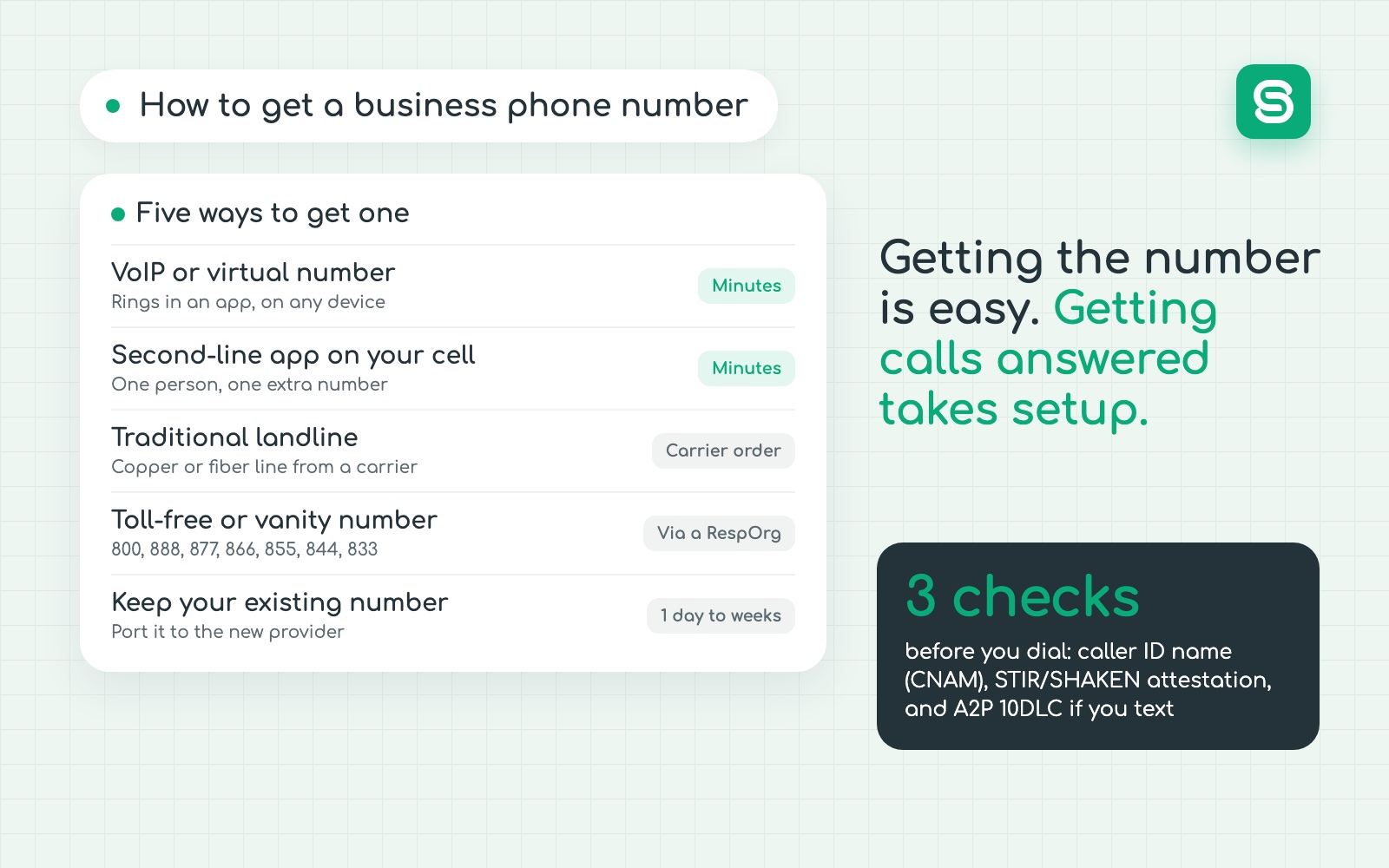
The five ways to get a business phone number
Every guide that ranks for this question lists providers. Almost none of them compares the routes first. Here they are, side by side, with what each one is good for and where it breaks.
VoIP or virtual number
- How it works
- A number hosted in the cloud, ringing in desktop and mobile apps or IP desk phones
- Time to get it
- Minutes, online
- Published price range
- About $10 to $30 per user per month (prices read November 25, 2026)
- Best for
- Almost every small business, remote teams, sales teams
Second-line app on your cell
- How it works
- An app that adds a second number to the phone you already carry
- Time to get it
- Minutes, from the app store
- Published price range
- Free consumer apps to about $15 to $20 per user per month for business plans
- Best for
- Solo owners and freelancers who want to stop sharing their personal cell
Traditional landline
- How it works
- A line from the local phone company, wired to a desk phone or an old office PBX
- Time to get it
- Depends on the carrier's order and install schedule
- Published price range
- Quote-based, often bundled with internet
- Best for
- A fixed site that needs a line independent of the internet connection
Toll-free or vanity number
- How it works
- An 800, 888, 877, 866, 855, 844 or 833 number reserved through a RespOrg, routed to your phones
- Time to get it
- Minutes to days, depending on the provider and the number you want
- Published price range
- Add-on, for example $4.99 per month for an extra number at RingCentral, plus usage
- Best for
- National brands taking inbound calls from customers across the country
Keep the number you have
- How it works
- Port it from your current carrier to the new provider
- Time to get it
- One business day for a simple port, often weeks for multi-line business ports
- Published price range
- Often free, but your old carrier may charge a fee
- Best for
- Any business whose number is already printed, listed and known
VoIP or virtual number: the default choice
A VoIP (voice over internet protocol) number lives in the cloud. You sign up, choose an area code, pick a number from a list, and it rings in an app on your computer and phone. There is no hardware to install, and adding a person is a matter of adding a license. This is what RingCentral, Nextiva, Dialpad, Zoom Phone, Google Voice, Quo and Skipcall all sell, with very different feature sets on top.
- Live in minutes, no technician, no contract required with many providers
- Same number on desktop, mobile and desk phone
- Choose any area code, whatever your physical location
- Call recording, transcription and CRM sync available on most business plans
- Needs a decent internet or mobile data connection
- 911 depends on the address you register with the provider
- Features vary a lot by tier: phone menus, queues and texting are often extra
The FCC is explicit about the 911 limit: VoIP 911 calls depend on the physical address you give your provider, and “VoIP service may not work during a power outage or when the internet connection fails”. If you are moving from copper lines, our comparison of VoIP vs traditional phone systems goes deeper, and the Business VoIP page shows what a cloud line includes at Skipcall.
A second-line app on your cell: the solo founder’s shortcut
If you work alone and live on your phone, a second-number app is the fastest route: install it, pick a number, and your phone now has two identities. Calls to the business number show up labeled in the app, and your personal number stays private. Quo’s pricing page puts it bluntly with a customer quote: “I used my personal cell number as the company number and I still regret it a decade later.”
Best for: A solo owner or a two-person shop who wants a separate business identity on the phone they already carry
The trade-off shows up when you hire. Consumer apps tie the number to a personal account. Business plans of the same apps fix that, at which point you are effectively buying a VoIP number. Our guide to putting a business number on your personal phone compares the setups, and our review of Google Voice for business covers the most common free starting point and where it stops.
A traditional landline: still a niche, not a default
A landline from the phone company still makes sense in narrow cases: an alarm panel, an elevator phone, a site where internet is unreliable, or a business that wants a line that does not depend on the router. For an office of people who talk to clients, a cloud number does the same job with more flexibility. Our guide to the business phone system explains the three generations (PBX, IP-PBX, cloud) if you are replacing an old office setup.
Toll-free and vanity numbers: for a national image
The FCC defines toll-free numbers as numbers with “distinct three-digit codes that can be dialed from landlines with no charge to the person placing the call”. There are seven toll-free codes: 800, 888, 877, 866, 855, 844 and 833. They are not interchangeable: 1-800-555-0100 and 1-888-555-0100 reach different subscribers.
Three facts from the FCC that most vendor guides leave out:
toll-free codes: 800, 888, 877, 866, 855, 844 and 833
Source : FCC
reserve toll-free numbers for subscribers, mostly first come, first served; Somos certifies them
Source : FCC
to hoard or broker toll-free numbers: you may not hold more than you intend to use, or sell one
Source : FCC
A vanity number is one that spells a word, such as 1-800-FLOWERS. Vanity local numbers exist too, but the choice is much thinner. Providers charge extra for them: RingCentral lists additional vanity numbers at a $30 one-time fee plus $4.99 per month (checked November 25, 2026).
Keeping your existing number: porting
If your number is already on your truck, your website and a thousand customer phones, keep it. Under FCC rules, if you stay in the same geographic area you can move your number between wireline, IP and wireless providers, and “your old company cannot refuse to port your number, even if you owe money”. Simple ports must be processed in one business day. Multi-line business ports take longer: RingCentral’s business phone numbers page quotes 7 to 14 business days.
The one rule that matters: do not cancel your old service before the port completes. The FCC’s own wording is “Do not terminate your service with your existing company before initiating new service with another company”, and providers add the second half: keep it running until the number has moved. Ignoring this is how businesses lose a number. Our full guide to business phone number porting covers the letter of authorization, the customer service record and the six mistakes that kill a port, and the number porting checklist by country lists the documents for each market. Note that porting into Skipcall is not available yet (it is coming soon): today, Skipcall gives you new numbers.
Which option fits your situation?
The right route depends less on the size of your company than on what the phone does all day. Four common profiles:
| Situation | What the number has to do | Route to look at first |
|---|---|---|
| Solo owner or freelancer | Separate business and personal calls, texting with clients | Second-line app or a single VoIP license |
| Small team (2 to 20 people) answering customers | One main number, a phone menu, business hours, a line per person | Cloud phone system with an auto-attendant, porting the existing number |
| Sales team calling out | Local numbers in the right area codes, clean caller ID, CRM logging, a dialer | Outbound-first VoIP with local numbers per region |
| Business selling in several states | Local presence in each market, or one national number | Local numbers per state for calling out, toll-free for national inbound |
Solo owner or freelancer
You need one thing: stop giving out your personal cell. A second-line app or a single VoIP license does it, and texting matters because clients will text you. Choose a local number in the area where your clients are, set a voicemail greeting with your business name, and register for texting if you send appointment reminders or confirmations from a platform.
Small team answering customers
Your main number receives calls that someone has to route: sales, support, billing, after hours. You need an auto-attendant (a phone menu), business-hours rules and probably call queues. That is the job of an all-in-one cloud phone system. Our comparison of the best small business phone systems prices twelve of them. Keep the existing main number by porting it, and give each employee a direct number if clients call them by name.
Sales team calling out
Your numbers are the first thing a prospect sees, so they are an asset to protect. You want a local area code that matches your prospects, numbers that carriers do not flag, call logging in the CRM, and a dialer so reps make 60 to 80 calls an hour instead of 20 to 25 by hand. You do not need a phone menu. This is where an outbound-first phone like Skipcall fits, with a power dialer or a parallel dialer on top of the numbers. Watch the spam section below: it matters more for you than for anyone.
Multi-state business
Two strategies, often combined. For inbound, one toll-free number gives a single national entry point. For outbound, one local number per region shows each prospect a familiar area code. Our guide to local presence dialing explains how to do it without rotating dozens of numbers, which carriers dislike.
Choose the number for the person who will see it. A customer calling you wants a number that is easy to remember. A prospect you are calling wants a number they recognize. Those are not always the same number.
How to get a business phone number, step by step
Here is the setup in the order that avoids rework. Steps 1 to 4 get you a number. Steps 5 to 8 are what separates a number that gets answered from one that gets ignored, and they are the steps the top-ranking guides skip. Step 9 makes sure people can find it.
- 01
Decide what the number is for.
Write down the three things it must do in week one: take calls on a main line, make outbound calls, text customers, appear on ads nationally. That list decides the type (local, toll-free, vanity) and the route (VoIP, second-line app, landline). If you have an existing number customers know, the answer is usually to port it and add new numbers next to it. - 02
Choose the area code.
For a local number, pick the area code where your customers or prospects are, not necessarily where you sit. A New York audience will recognize 212 or 646, a Chicago one 312. If you target several regions, plan one number per region rather than one number for everything. A VoIP number does not require an office in that area. - 03
Pick the provider.
Match the provider to the job: a cloud phone system for inbound routing, a second-line app for a solo owner, an outbound-first phone for a sales team. Check four things on the pricing page: the price billed monthly vs annually, how many numbers are included per user, the price of extra numbers, and which tier includes texting. - 04
Sign up and claim the number.
Create the account, search numbers by area code, pick one and confirm. With most VoIP providers the number is active immediately. Some countries outside the US and Canada require a company document first: our business phone number requirements tool lists them country by country. - 05
Set your caller ID name (CNAM).
Ask your provider to register the business name shown on calls. Without it, the recipient’s carrier shows the city and state of the number by default. Keep it short and clear: CNAM is limited to 15 characters. - 06
Check STIR/SHAKEN attestation.
Ask your provider whether your outbound calls are signed and at what attestation level. Level A means the provider knows you and confirms you have the right to use the number. It is the level you want on every call. - 07
Register for A2P 10DLC if you will text.
Business texts from a regular 10-digit US number must be registered with The Campaign Registry: your brand (company identity) and your campaign (use case, sample messages, opt-in method). Do it before you need to send, not on launch day. - 08
Record the voicemail greeting and set your hours.
Record a greeting with the business name, what the caller should leave, and when they will hear back. Set business hours or do-not-disturb so after-hours calls go to voicemail instead of waking you up. Our voicemail greeting scripts give you ready-to-record versions. - 09
Publish the number, the same way everywhere.
Put it on your website header and contact page, your Google Business Profile, your email signatures, invoices and quotes, and the directories you are listed in. Write it in the same format everywhere and retire the old number from every listing at the same time, so customers and search engines never see two numbers for one business.
The rest of this section explains steps 5 to 8, because they are where a new business number quietly fails.
Caller ID name (CNAM): the name next to your number
CNAM stands for Caller ID Name. Twilio’s documentation describes it as “a feature in the United States public telephone network that identifies an incoming caller by the business name associated with the calling party”. Three things to know before you rely on it:
Our guide to CNAM caller name display explains how to check what people actually see, and when a branded caller ID service (logo and call reason on supported phones) is worth paying for.
STIR/SHAKEN: the signature on your calls
In 2020 the FCC adopted rules requiring voice providers to implement STIR/SHAKEN in their IP networks by June 30, 2021. In the FCC’s words, it lets carriers have calls “signed as legitimate by originating carriers and validated by other carriers before reaching consumers”, and it “helps supports providers’ blocking decisions and call labeling efforts”. In plain English: a signed call is less likely to be blocked or labeled.
Each signed call carries an attestation level. Twilio’s documentation summarizes the three levels:
| Level | What the provider vouches for | When you get it |
|---|---|---|
| A: full attestation | It knows the customer and confirms they have the right to use the number shown as caller ID | Calling from a number your own provider rents to you |
| B: partial attestation | It knows the customer, but not whether they have the right to use that caller ID | Displaying a number hosted somewhere else |
| C: gateway attestation | Neither, including calls that enter the network from abroad | Calls passed in from another network; carriers trust these the least |
The practical rule: make outbound calls from numbers your provider owns and signs, rather than displaying a number hosted elsewhere. Our guide to STIR/SHAKEN caller ID authentication covers the details and what to ask a provider.
A2P 10DLC: registration before you text
A2P 10DLC (application-to-person messaging over 10-digit long codes) is the US carriers’ registration system for business texting from regular local numbers. Quo’s pricing page sums up why it matters: registration is required “to guarantee message deliverability to three major US carriers (AT&T, T-Mobile, and Verizon)”. You register two things through The Campaign Registry (TCR), usually via your provider: your brand (legal name, EIN, address, website) and your campaign (what you send, sample messages, how people opt in).
The fees are small and passed through by providers. Twilio’s published A2P 10DLC fees, read November 25, 2026:
one-time brand registration, Sole Proprietor or Low Volume Standard brand
Source : Twilio
one-time Standard brand registration, secondary vetting included
Source : Twilio
campaign vetting fee, per campaign submitted
Source : Twilio
per campaign per month: $1.50 low-volume mixed, $2 sole prop, $10 standard
Source : Twilio
Other providers package it differently: Quo, for example, shows a one-time $19.50 TCR fee and a $1.50 to $3 monthly messaging fee on its pricing page. Carriers also add per-message fees on registered traffic. Toll-free numbers are outside the 10DLC system (Twilio says so explicitly), and providers handle toll-free texting through a separate verification.
The real cost is time: campaigns are reviewed manually, and a rejection means another fee and another wait. Our dedicated guide to A2P 10DLC registration and cold texting rules covers the forms, the common rejection reasons and what federal law says about texting people who did not opt in.
Voicemail greeting and hours
A missed call to a business number with the carrier’s default robot greeting (“the person you are calling is not available”) is a lost lead. Record your own in the first hour:
Then set your hours: forward business-hours calls to the people on duty, send after-hours calls to voicemail, and turn on voicemail transcription so messages reach you as text. If your team works remote or across time zones, our guide to a remote team phone system covers the routing.
And one more for VoIP: the 911 address
FCC rules require interconnected VoIP providers to obtain “a customer’s physical location prior to service activation” and to give you easy ways to update it. Enter the real street address where each user works, and update it when someone moves. It takes a minute and it decides where an emergency call goes.
What a business phone number really costs
The number itself is rarely the expensive part. You pay for the service around it: the license, extra numbers, texting registration, and taxes and fees that never appear on the pricing page. Published prices read on November 25, 2026:
Google Voice
- Starter
- $10 per user per month (up to 10 users), also a one-user Voice-only option at $10
- Standard
- $20 per user per month, adds auto attendants and ring groups
- Premier
- $30 per user per month
- Also needed
- A Google Workspace plan, except the one-user Voice-only option
Quo (formerly OpenPhone)
- Starter
- $15 per user per month billed annually, $19 monthly
- Business
- $23 annually, $33 monthly: phone menus, auto recording
- Numbers
- One local or toll-free number per user; extra numbers $5 per month each
- Texting
- $19.50 one-time TCR fee and $1.50 to $3 per month
RingCentral
- RingEX Core
- $20 per user per month billed annually, $30 monthly (1 to 5 users column)
- Included
- Unlimited domestic calling, 100 toll-free minutes, 25 SMS per user per month
- Extra numbers
- $4.99 per month for an additional local or toll-free number
- Vanity number
- $30 one-time fee plus $4.99 per month
 Skipcall
- Business VoIP
- From $25 per user per month billed annually ($30 monthly)
- Included
- 1 number, 150 conversations, 100 SMS per month
- US numbers
- Local area code of your choice, no documents, activated immediately
- Not included
- Toll-free numbers, IVR, call queues, inbound routing
Three cost traps to check on any quote:
For a wider view of what phone service costs a whole team (headsets, internet, desk phones), see our guide to business VoIP phone service.
The mistakes that ruin a new business number
Most business numbers do not fail on day one. They fail in month three, when calls stop getting answered or texts stop arriving, and nobody knows why. The usual causes:
Avoiding the spam label
The biggest risk for any number that calls out is the “Spam Likely” label. Carriers and their analytics partners (Hiya, First Orion and TNS) score numbers on behavior and complaints. Four steps cut the risk sharply:
Register your numbers with the Free Caller Registry
The Free Caller Registry, backed by Hiya, First Orion and TNS, lets a business register its outbound numbers with the three call-labeling providers at once, for free. Do it the day you get a number.
Call from numbers your provider signs with A-level attestation
That means numbers rented from your phone provider, not a number from another carrier displayed as caller ID.
Keep volume per number moderate and steady
Avoid spikes, and avoid rotating through dozens of fresh numbers: carriers read constant rotation as a warning sign.
Check your numbers every week
Call a few colleagues on different carriers and look at what their phones show. If a label appears, act early.
If a number is already flagged, our guide on why a business number gets marked as spam walks through the diagnosis and the fix, and our explainer on caller ID reputation covers how the scores work. To check that a list of numbers is valid and correctly formatted before you dial it, use our free phone number validator.
How to get a business phone number with Skipcall

Skipcall is an outbound-first business phone: it is built for teams whose people make more calls than they receive. If that is you, getting a US number takes a few minutes:
- 01
Create your account.
Sign up at app.skipcall.io/signup. One license is enough, with no long-term commitment. - 02
Pick a US local number.
Choose the area code of your choice. A US number needs no supporting document, no US address and no US company: it is activated immediately. Canada works the same way. Other countries require a company document. - 03
Call from anywhere.
Use the web app or the iOS and Android apps. The same number goes with you from the laptop to the phone. - 04
Add the dialer when you need it.
Every plan, Business VoIP included, records, transcribes and summarizes calls with AI. From Starter, the power dialer calls one number at a time and the parallel dialer up to four at once, with AI voicemail detection, and calls sync to HubSpot, Pipedrive, Salesforce or Attio.
Not for: A front desk that needs a phone menu, call queues or inbound routing between departments, or a toll-free number: Skipcall does not offer them, and an all-in-one cloud phone system is the better fit
If you want the five-minute walkthrough with screenshots, our guide on how to get a virtual phone number follows the clock minute by minute. Plans and quotas are on the pricing page.
What to remember
Getting a business phone number is a ten-minute job. Getting one that works for the next five years takes a little more thought. Decide first what the number has to do: take calls, make calls, text, or carry a national brand. For most small businesses, that points to a local VoIP number in the area code your customers recognize; for a solo owner, a second-line app; for a national inbound line, a toll-free number next to local ones; and for a number people already know, a port, without canceling the old line first. Then finish the setup most guides never mention: a 15-character caller ID name, calls signed with A-level STIR/SHAKEN attestation, A2P 10DLC registration before the first text, the Free Caller Registry, a real voicemail greeting and the right 911 address. That is the difference between a number people answer and a number they ignore.
Sources
Prices and terms read on November 25, 2026 on the following official pages:
- Google Workspace, Google Voice plans.
- Quo, pricing (plans, additional numbers, Campaign Registry fees).
- RingCentral, RingEX plans and pricing (Core price, additional numbers, vanity numbers) and business phone numbers (porting timeline of 7 to 14 business days).
- Twilio Help Center, Pricing and fees for A2P 10DLC service.
Regulation and standards:
- FCC, Toll free numbers (toll-free codes, RespOrgs, Somos, vanity numbers, warehousing and hoarding).
- FCC, Porting: keeping your phone number when you change providers.
- FCC, Combating spoofed robocalls with caller ID authentication (STIR/SHAKEN).
- FCC, VoIP and 911 service.
- Twilio Docs, Trusted calling with SHAKEN/STIR (attestation levels A, B and C).
- Twilio Help Center, Getting started with CNAM caller ID (15-character limit, display by the receiving carrier).
- Free Caller Registry (Hiya, First Orion, TNS).




